Tuesday, January 17, 2012

Is Health Spending Growth A Sign Things Are Getting Better?

The massive growth in government debt stretching far into the future, Yglesias says,
is driven, everyone knows, primarily by Medicare. Edsall emphasizes the role of an aging population, but the more fundamental issue is that we’ve been fortunate to benefit from untold numbers of useful medical innovations that have changed what it means to be committed to providing health care to the elderly. That is to say, it’s more a crisis of abundance than of scarcity. If we stop inventing new treatments, then costs will tumble as patents (and patients) expire. Indeed, the 2003 bill adding a prescription drug benefit to Medicare has turned out to be cheaper than expected, largely because the pace at which new medicines are invented has slowed. Common sense says that was a bad thing, and that a zero-innovation future would be bleak

Monday, December 19, 2011

Basic epidemiology, psychology, and overprescription

Levitin @ NYT:
Suppose you’ve just found out that you or a loved one has prostate cancer, ...Nearly every urologist would recommend radical surgery to remove the organ. Sounds reasonable, doesn’t it? 
But let’s look at the numbers... Prostate cancer is slow-moving; more people die with it than from it. According to one 2004 study, for every 48 prostate surgeries performed, only one patient benefits — the other 47 patients would have lived just as long without surgery... Moreover, the 47 who didn’t need the surgery are often left with an array of unpleasant and irreversible side effects, including incontinence, impotence and loss of sexual desire. The likelihood of one of these side effects is over 50 percent — 24 of our 47 will have at least one. This means a patient is 24 times more likely to experience the side effect than the cure.
...the “risk for disease,” ...is important to untangling disease statistics. Say a drug promises to reduce your risk of fatal illness X by 50 percent. Sounds great, doesn’t it? But suppose there was only a one-in-1,000 chance that you’d get the disease to begin with: reducing your risk by 50 percent means that you’ll now have a one-in-2,000 chance of getting it. Most medications have side effects, and the likelihood of these may far exceed that of being helped by the medication. For example, the “number needed to treat” for a particular cholesterol-­lowering drug is 300. (For every 300 people taking it, only one heart attack is prevented.) The drug has a 5 percent probability of side effects, including severe muscle and joint pain and gastrointestinal distress. Thus, for every person helped, 15 people (5 percent of 300) will experience side effects and not be cured. In other words, anyone taking the drug is 15 times more likely to experience the unwanted effects of the medication than the beneficial ones.
Of course, none of us want to think of ourselves as a statistic... studies by cognitive psychologists have shown that our brains are not configured to think statistically, whether the question is how to find the best price on paper towels or whether to have back surgery. In one famous study, Amos Tversky and Daniel Kahneman found that even doctors and statisticians made an astonishing number of inference errors in mock cases; if those cases had been real, many people would have died needlessly. The problem is that our brains overestimate the generalizability of anecdotes. Scientists call anecdotes the “n of 1,” pseudo-experiments with no controls and only one subject. The power of modern scientific method comes from random assignment of treatment conditions; some proportion of people will get better by doing nothing, and without a controlled experiment it is impossible to tell whether that homeopathic thistle tea that helped Aunt Marge is really doing anything.
...Returning to prostate surgery, consider that six weeks is the ...recovery period. Coincidentally, the operation will, on average, add six weeks to your life. (This averages across the 47 people who had no benefit from the operation and the one person who did.) To my way of thinking, the decision then becomes this: When do you want to “spend” those six weeks? When you’re relatively young and feeling well, or at the end of your life, when you’re old and only dimly aware of your surroundings? 

GROOPMAN and HARTZBAND @ WSJ:
Consider the case of Susan Powell..., a nurse's assistant now in her 50s. She had been healthy all her life, but when she turned 45, she decided to see a primary-care doctor. Susan ate healthy foods and was physically active, but she was a bit overweight, and her blood tests showed that she had high cholesterol. Her doctor prescribed a statin drug... Statins are among the most commonly prescribed medications in the world. In the U.S. alone, more than 25 million people take the drugs to lower their cholesterol, ...a key factor leading to heart attack and stroke.  Soon after seeing her doctor, Susan spoke with an acquaintance at church who had developed muscle pain after starting to take a statin. Susan also thought of her father, who had high cholesterol and never took ...medication... "People take too many pills," he often told his children. He lived a long, full and active life. 
Susan decided not to take the statin.
Many people decline treatment because they know someone who suffered from side effects... Stories deeply affect all of us, and they can make real the risks and benefits that might otherwise seem abstract—but they can also distort our vision by making the rare appear routine.
Statistics can help to put lessons drawn from stories into a larger context, letting us make a more considered choice...
At Susan's follow-up appointment..., her doctor told her that "by taking a statin pill, you'll reduce your risk of a heart attack over the next 10 years by as much as 30%." The risk of side effects, she continued, was very small, and the benefits far outweighed the risk. Susan promised to give it serious thought.
She continued to search for information, reading everything she could about cholesterol. What caught her eye was a ... "10-Year Heart Attack Risk Calculator."
She entered her age, total cholesterol number of 240, and "good" cholesterol (HDL) of 37. She was not a smoker, her blood pressure was fine, and she was on no medications. The result: "Risk Score: 1%: Means 1 of 100 people with this level of risk will have a heart attack in the next 10 years."
This means that 99 of 100 people like me won't have a heart attack in the next 10 years, Susan told herself. She started to feel much better. She had found a key number in health literacy: her risk for disease without treatment.
Without treatment, Susan's risk for a heart attack was 1 in 100. If 1 in 100 women has a heart attack, that means... 3 in 300. The statin treatment reduces risk by 30%, or about one-third.
Let's apply that benefit to a group of 300 women like Susan, where three would have a heart attack without taking statins. If we treat them all, we would prevent one heart attack—because we protect one-third of those three. The other two women would still have a heart attack despite taking the medicine. The remaining 297 would not have had a heart attack even without the medication, so they wouldn't benefit from taking it.
This statistic comes as a surprise to many people. When you hear that a statin lowers Susan's risk by 30%, it sounds as if she is at a 100% risk of suffering a heart attack if she doesn't take the medication.
Another component of health literacy is understanding the risks of a therapy. Statins cause muscle pain in 1% to 10% of people who take them. However, if we "flip" the frame, the number without any side effects is 90 to 99 out of 100, a much more reassuring statistic.
Advertisements for drugs ...are designed to communicate a compelling tale. ...In 2007, a team of researchers from the UCLA Medical Center and other medical centers studied prescription drug ads broadcast on national networks. They found that the average American TV viewer sees over 1,000 prescription drug ads in the space of a year. That's 16 hours all told—much more time than the average person spends with his or her primary-care physician.
The study concluded that the large majority of TV ads fail to fulfill an educational purpose. But they clearly work, ...: Every $1,000 spent on advertising translated into 24 new prescriptions...
Another illuminating study ...examined the impact of printed drug ads on patient preferences. One group was given actual ads. A second group received the same ads, except that the brief summary at the end of the text was replaced by a "drug-facts box." [like the nutritional facts box on packaged foods] The box presented information in a clear, accessible fashion, similar to the ...the benefits and risks of a statin for Susan [presented above].
The results of the Dartmouth research are impressive. Nearly two-thirds of the group that saw the original ads overestimated the benefits... They believed it was 10 times more effective than it actually was. But nearly three-quarters of the participants who saw the information in the drug-facts box correctly assessed the actual benefits...
Even more striking was another finding. When people were given readily understandable information about the statin's actual benefit in preventing future heart disease, nearly twice as many said they wouldn't take the drug in light of its side effects. When given clearer information, the patients weighed the risks and benefits differently ...and were less likely to take the medication.

Tuesday, December 6, 2011

Should car dealers be forced to post the prices that they charge each customer for new cars?  Why should health care be any different?  Yglesias:
Josh Barro at National Review writes in favor of the idea that the law ought to require "hospitals and medical practices to disclose their full price lists—both the inflated list prices and the rates negotiated with each insurer that the practice accepts."
To my way of thinking, this is a moderately good idea. I remarked on twitter, however, that it didn't strike me as a particularly free markety idea. That's fine by me. Sometimes heavy-handed regulation is what you need. But others seemed to push back and say that anything aiming at providing more information about prices is per se a pro-market intervention. I don't think that's correct. Opaque pricing is a pretty common feature of the economy. Cable companies, for example, will often offer pretty steep discounts to customers who threaten to cancel service. The marginal cost of providing cable to an additional household is very low, so it's worth knuckling under to pressure. But obviously cable companies don't want to disclose how low they're willing to go, since if they did that would strengthen everyone's else's hand in bargaining. In general, full disclosure of how much you pay/charge your employees/clients/suppliers/customers would be pretty poor negotiating strategy in a wide variety of contexts so it doesn't exist in a market equilibrium. Rules banning price secrecy across the board would, whether you like them or not, be a very drastic regulatory intervention into the marketplace.

Waiting In America

Aaron Carroll:
Some days it’s hard to be a blogger. Yesterday, I told a story about how the local Minute Clinic filled a niche by providing timely care on off hours for a simple acute issue. Nevertheless, I got a lot of email accusing me of being a shill for Walmart and selling out the medical profession. Please.
Look, I clearly said at the end of my piece that I don’t think retail clinics are good for everything. I think longitudinal care through a medical home is proper for primary care. But there are limits. There are times when you need to see a health care professional early in the morning, or later at night. Have you tried to get an appointment lately when you’re sick? It’s hard! That’s not all. You often have to wait a while:

So almost 20% of people need to wait at least a week to see a doctor when they are sick. Try getting a same day appointment if you can. Or, even better, try getting an appointment before or after work. Or on a weekend:

Yeah, we beat Canada. But we lose to almost every other country. Almost two thirds of Americans have trouble getting care on nights, weekends, and holidays. You know what? A significant amount of the week is filled with nights, weekends, and holidays. Especially if you don’t want to miss work.
It’s fine to believe that people should try and see the doctor in the office. But if you want that to happen, then you need the office to be available. If retail clinics do a much better job in that respect, you can’t complain when people make use of them. In my example, my kids could be seen at 8AM, before school, without an appointment. That’s useful. If physician offices want that business, they should do the same.

Tuesday, November 15, 2011

Reagan Mandated Universal Health Care In 1986

President Reagan gave the US already a universal health care system that does not discriminate according to ability to pay.  But our universal health care system is so incomplete and strained that most people do not even realize that the US government already mandated universal health care.  
From Wikipedia [slightly edited]:
The Emergency Medical Treatment and Active Labor Act (EMTALA) requires hospitals to provide care to anyone needing emergency healthcare treatment regardless of citizenship, legal status or ability to pay. There are no reimbursement provisions. Participating hospitals may only transfer or discharge patients needing emergency treatment can be discharged only under their own informed consent, after stabilization, or when their condition requires transfer to a hospital better equipped to administer the treatment.  EMTALA applies to "participating hospitals." The statute defines "participating hospitals" as those that accept payment from the Department of Health and Human Services, Centers for Medicare and Medicaid Services (CMS) under the Medicare program. However, in practical terms, EMTALA applies to virtually all hospitals in the U.S., with the exception of the Shriners Hospitals for Children, Indian Health Service hospitals, and Veterans Affairs hospitals. The combined payments of Medicare and Medicaid, $602 billion in 2004, or roughly 44% of all medical expenditures in the U.S., make not participating in EMTALA impractical for nearly all hospitals.

The most significant effect is that, regardless of insurance status, participating hospitals cannot deny urgent medical assistance. Currently EMTALA only requires that hospitals stabilize the emergency. According to some analyses of the U.S. health care safety net, EMTALA is an incomplete and strained program. Cost pressures on hospitals

According to the Centers for Medicare & Medicaid Services, 55% of U.S. emergency care now goes uncompensated. When medical bills go unpaid, health care providers must either shift the costs onto those who can pay or go uncompensated. In the first decade of EMTALA, such cost-shifting amounted to a hidden tax levied by providers. For example, it has been estimated that this cost shifting amounted to $455 per individual or $1,186 per family in California each year.

However, because of the recent influence of managed care and other cost control initiatives by insurance companies, hospitals are less able to shift costs, and end up writing off more in uncompensated care. The amount of uncompensated care delivered by nonfederal community hospitals grew from $6.1 billion in 1983 to $40.7 billion in 2004, according to a 2004 report from the Kaiser Commission on Medicaid and the Uninsured, but it is unclear what percentage of this was emergency care and therefore attributable to EMTALA.

Financial pressures on hospitals in the 20 years since EMTALA's passage have caused them to consolidate and close facilities, contributing to emergency room overcrowding. According to the Institute of Medicine, between 1993 and 2003, emergency room visits in the U.S. grew by 26 percent, while in the same period, the number of emergency departments declined by 425. If the emergency room is overloaded, patients must be treated in an order based on their determined medical needs, not their ability to pay. But ambulances are frequently diverted from overcrowded emergency departments to other hospitals that may be farther away. In 2003, ambulances were diverted over a half a million times.  

Saturday, November 12, 2011

Arbitrary Pricing

Price discrimination usually causes businesses to charge poorer people less because they are more likely to walk away if the price is high, but in health, the insurance companies pay less because they have more bargaining clout (and information) and it is hard or impossible to just walk away when you are sick.  Washington Post:
In a report this past spring, the state found that some Massachusetts doctors charge six or seven times as much as their colleagues for the exact same procedures. Across the board, a three-fold variation in prices was pretty standard.
There’s a pretty simple explanation for all the price variation: hospitals negotiate specific rates for specific insurance companies. They gauge the size of the insurance company and how many patients it would be expected to bring in, and then set a price. Insurers and hospitals alike closely guard those pricing agreements as proprietary information, with neither party wanting to see their pricing agreement undercut by a competitor.
Massachusetts wants to do away with all of that. In a proposal released Wednesday, the Massachusetts Special Commission on Provider Price Reform recommends allowing a panel of state regulators to reject rates charged by hospitals and providers if they’re too high. The report, which you can read here, also proposes the creation of a claims database, which would allow the public to see how much their health care actually costs.
That would be a really big shift from where we are now, where price negotiations are usually a private matter between insurers and providers, and it’s nearly impossible to figure out how much a given procedure costs. A recent Government Accountability Organization report really hit home on this. The agency called up 17 hospitals at random to ask how much a knee replacement would cost. Not a single one of them could name a price for one of the country’s most common surgeries.

Sunday, October 2, 2011

Doctors Respond To Incentives

Austin Frakt is a physician who writes about health economics with some health economists and other researchers.  He has summarized several studies that show how doctors change their behavior when they are paid for services versus paid via capitation. 
Fee for service payment of physicians is often blamed as a contributor to high and rapidly growing health care costs. In an analysis of primary care physicians, Helmchen and Lo Sasso provide a sense of how physicians respond to different compensation schedules:
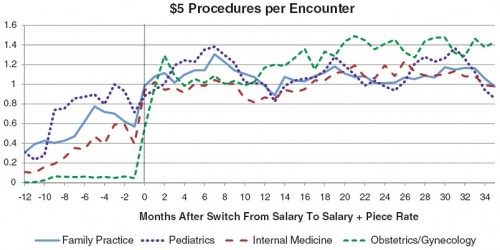
Using a four-year [2003-2006] sample of 59 physicians and 1.1 million encounters, we study how physicians at a network of primary care clinics responded when their salaried compensation plan was replaced with a lower salary plus substantial piece rates for encounters and select procedures. Although patient characteristics remained unchanged, physicians increased encounters by 11 to 61%, both by increasing encounters per day and days worked at the network, and increased procedures to the maximum reimbursable level.
The extra payment that so dramatically increased encounters was $5 for each reported performance of an eligible procedure. The number of procedures per encounter in each month that qualify for the $5 bonus is illustrated in the following figure by practice area:

The policy implication is obvious, right? Paying fee for service is asking for higher costs. So, we could cut costs by reducing or eliminating piece rate based (fee for service) payment. Case closed.
Not so fast! Let’s talk about what those $5 bonus payment eligible procedures were.
[T]he network began paying physicians $5 for each reported instance of most immunizations for children and adults as well as counseling and screening services aimed at detecting or preventing risk behaviors such as substance abuse, contraction of infectious disease, suicide, obesity, and the patient’s exposure to violence. Importantly, physicians were only remunerated for an average of one $5 procedure per encounter.
It is not at all obvious that the extra money spent encouraging these particular procedures was not worth the personal and population health value they conferred. Put it this way, would you argue that the individuals who received those services should not have, that those services were part of the problem of overuse of unnecessary care? That is a hard argument to make. Yet the data show that without the extra $5 the studied physicians provided fewer of those very services.
As the authors point out, to make that precise, one would need to quantify the health gains and adjust for whether the provision of extra services by these physicians didn’t just offset a reduction of services by others for the same patients (crowd out). By doing so, it is possible to make a good argument that more health spending is worth the cost (see my post on Cutler’s book that makes this very argument, but with numbers.) This is important to keep in mind. Fee for service isn’t all bad. It just needs to be applied in a more nuanced way. Not all physician compensation should be fee for service. But some should be.
 And another study found sick patients do poorly under a capitation scheme whereas healthy people do poorly under a fee-for-service payment scheme. 

In case there is any doubt, a new study using experimental methods shows that how physicians get paid and by how much does affect patient care, but it is not the only factor. The health of patients matter too.... The paper, by Heike Hennig-Schmidt, Reinhard Selten, and Daniel Wiesen, appeared in the Journal of Health Economics and is titled How payment systems affect physicians’ provision behaviour—An experimental investigation. As the title states, this was an experiment, not an observational study.... the findings:
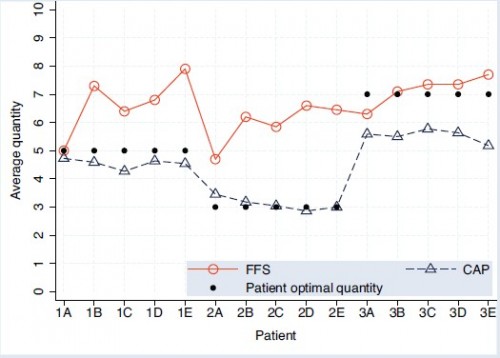
  1. Payment systems matter. More services are provided under FFS than CAP. On average, patients receive more services than are optimal under the former and fewer than optimal under the latter.
  2. Patient health matters. That is, physicians do respond to how much treatment benefits patients. Still, under FFS, patients in good and intermediate health are overserved. Under CAP, patients in poor and intermediate health are underserved.
  3. Payment systems affect health (or patient benefit). Patients in good and intermediate health suffer losses under FFS due to overprovision. Patients in intermediate and poor health suffer losses under CAP due to underprovision.
It should be perfectly clear from these results why patients in the real world might self-sort according to health, even aspects of health that are unobservable to the researcher. A patient in poor health attempting to optimize his benefit would do better under FFS. A patient in good health gets better results under CAP.
Even though I already stated the results, the following chart conveys them so beautifully you really must take a look.... 
 
A-E are the (abstract) illness types and 1-3 index how much medical care would be optimal. The solid, black dots show the optimal level of care. Patients of type 1 (1A, 1B, etc.) would do best with 5 units of care, etc. Notice that under both payment systems, actual quantity provided is correlated with what would be optimal, highest for type 3 patients, lowest for type 2. So, patient needs matter. Still, patients needs don’t tell the whole story. Provision of care under both payment types differs from optimality, most strongly for types 1 and 2 under FFS and type 3 under CAP. Finally, CAP levels of care are systematically lower than under FFS. Conclusion: money matters, though so do patients. Lesson: your doctors, or medical providers generally, are not just taking care of you. They’re taking care of business (themselves) too.